Thursday, September 27, 2018

Yotam Ottolenghi’s Middle Eastern recipes

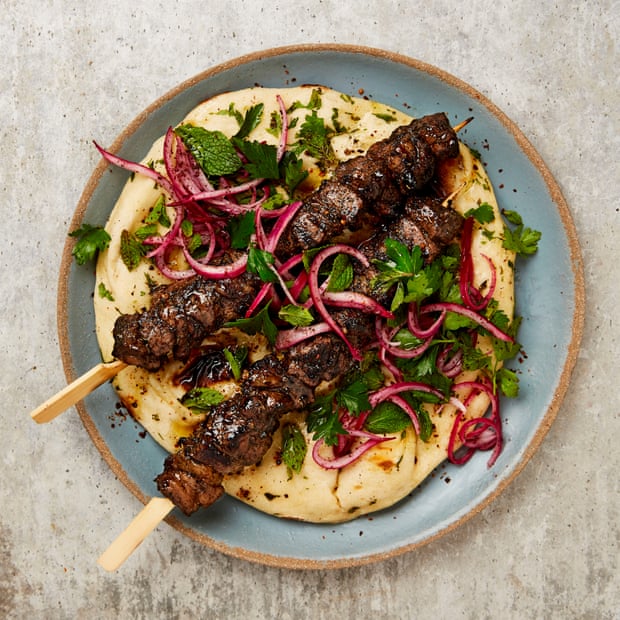
Put the steaks on a board and cover with a sheet of clingfilm. Using a mallet or the base of small, heavy saucepan, bash the steaks until they are about 1.5cm thick. Cut up the steaks, fat and all, into 1.5cm cubes and put in a bowl with the ground black lime, lemon zest and juice, cumin, garlic, two tablespoons of olive oil, a teaspoon and a half of salt and a good grind of pepper. Leave to marinate at room temperature for at least two hours (or refrigerated overnight).
For the sumac onions, mix the onion, sumac, vinegar and an eighth of a teaspoon of salt, and leave to soften for at least 30 minutes.
Thread the beef on to the skewers, packing the cubes closely together. Generously grease a grill pan with sunflower oil and put on a high heat. Once smoking, lay in the skewers in batches and cook, turning as you go, for about three to four minutes in total, until charred all over but not over-cooked. Transfer to a tray and cover with foil to keep warm.
Warm the bread on a hot grill for about 30 seconds on each side.
To serve, put a flatbread on each plate and top with two beef skewers each, brushing them with the remaining tablespoon of olive oil and sprinkling with the chilli. Toss the parsley and mint into the sumac onions, divide the mixture between the plates and serve.

Tuesday, August 28, 2018

Food insecurity and mental health 'interconnected'


As food insecurity persists in the London area, it’s becoming clear it affects more than hunger.

An article published in the Canadian Journal of Psychiatry points to a connection between food insecurity and the use of mental health services in Ontario.

About one in eight Canadians experience food insecurity. Those who experience severe food insecurity, missing meals or even going days without eating, were much more likely to receive mental health treatment compared to food-secure adults, the article states.

"Those people struggling with mental health issues are often the ones who are food insecure," said public health dietitian Ellen Lakusiak.

The article found 20 per cent of those who visited primary care doctors for mental health reasons were food insecure and about 27 per cent of those who visited a psychiatrist were food insecure.


However, the research article also pointed to food insecurity having consequences for the health care system, outside of mental health. Food insecure adults account for about 38 per cent of those admitted to hospital and about 35 per cent of those treated in emergency departments.

Lakusiak also is the co-ordinator of the Middlesex London Food Policy Council, which works to advocate, influence policy and make a difference to the local food system. The council assessed food insecurity in the city and Middlesex County in 2015 and 2016.

"Based on the data, we’re not any worse or better compared to other communities, but we definitely have food insecurity issues," she said.

Lakusiak said dietitians are dealing with mental health concerns more frequently.

"There is a push now to work more on mental health," she said. "It’s very much interconnected."

To end food insecurity, underlying community issues like poverty must be addressed first. Poverty creates food insecurity and mental health concerns, said LifeSpin executive director Jacqueline Thompson.

"It’s a downward spiral," she said.

Those living in poverty do not have access to proper shelter and nutrition, Thompson said.

"They have no money for food and they are not eating a nice diet," she said. "Food budgets are being used to pay for housing."

Income support programs like Ontario Works do not provide enough to cover food and rent, said London Food Bank co-director Glen Pearson.

"Food is one of the things they have to sacrifice to pay rent. That’s not the way it should be," he said. "People should be able to afford their own food, but people need an income to do that."

Lack of a healthful diet also can prevent those living with food insecurity from workplace opportunities, said Thompson.

"They are not able to sustain employment because they have no nutrition to get them through the day," she said.

Thompson said London is "miles" away from addressing these issues.

"London doesn’t have a whole lot of anything," she said.

While services such as Mission Services and the Salvation Army provide meals as a short-term solution, Pearson said the ultimate goal is to have food security.

"There is no need for someone in London to go hungry," he said.
Wednesday, July 18, 2018

Healthy food choices are easy, even while on vacation

Vacations are a much-needed break from our daily routine but can also make it a little more challenging to eat well and stay on track with our health goals. Whether you're taking a family trip up north, heading to a new city or hitting the beach, here are my top five strategies to help you to make balanced food choices while away from home.

1. You're already planning, so don't forget to plan some meals too; it will be easier to make nutritious choices if you know exactly what you're getting yourself into. Before leaving, hit the web to research what restaurants, markets or grocery stores will be near you. Look at your daily travel plans to determine when and where you might be eating your meals. This information will help you narrow down what to pack food-wise and where to eat once you arrive. If your room has a stove, fridge or microwave, buy a few groceries to make your own healthy meals or snacks.

2. Focus on portion control. Travelling often means eating out. Whether it's at the airport, on the road or in a new town, be aware of larger portions. Restaurants are notorious for serving a meal that's two or three times the size you should eat. Aim to choose lean proteins that have been grilled, roasted or baked, and opt for extra veggies or a side salad instead of excess starches or grains. You can also try splitting a meal with a friend or family member to keep portions more reasonable. Don't forget to slow down your eating and take sips of water between bites so that you aren't rushing through your meal and filling up before you even notice you're satisfied.

3. Try to stick to a regular meal routine. When food is constantly made available — like at an all-inclusive resort or cottage — it can be tempting to graze and overeat throughout the day. On the other hand, if you've got an action-packed sightseeing agenda, it can be easy to skip out on meals and snacks. Plan to eat every three to five hours; a regular pattern will keep you energized and help prevent overeating or digestive issues.

4. Drink water to stay hydrated as much as possible; the calories in fruity drinks, fancy coffees and alcohol can add up quickly. Often, we also mistake hunger for thirst, so keeping a bottle of water nearby and drinking throughout the day can help curb overeating and reduce temptation of extra snacks or treats we may encounter on our journeys.

5. Limit your indulgences. Vacation is a time to relax and pamper yourself, but this doesn't have to mean indulging every chance you get. Work on limiting those sweet treats and calorie-laden dishes. If there is a small treat that you'd love to taste, go for it. But take the time to enjoy every bite — it's likely you will only need a couple bites to feel satisfied.

Monday, June 25, 2018

Tatar's national dessert chak-chak is a hit in Kazan

KAZAN, Russia (AP) -- There are arguably more chak-chaks for sale in Kazan's shops, cafes and restaurants than fans attending World Cup matches in the colorful city on the Volga river.

Traditionally eaten at weddings in central Asia, the sugary treat has become the national dessert of Tatarstan, the oil-rich region which promotes itself as the "Land of 1,001 Delights."

In the lively Bauman pedestrian street in downtown Kazan, vendors from the fast food chain Tubetey, which specializes in halal Tatar cuisine, are handing out the dish made from soft deep-fried dough, sugar and honey.

"When I was a kid, my parents, my relatives, used to make them at home. I grew up with chak-chaks," said Nourbek Batulla, a 30-year-old dancer told The Associated Press. "I would not say that I eat chak-chaks every day, but this is typically the kind of thing I bring when I'm invited somewhere."

Chak-chaks come in different shapes, most often in mounds, pyramids or noodles. During the World Cup, they are on display on the shelves of dozens of souvenir and food stores as Tatarstan's tourism officials use the dish to promote their region.

But it's not just for the tourists. Chak-chaks are truly loved by locals. Expensive in the ancient times because honey was a very rare commodity, chak-chaks are sold for about 30 rubles in Kazan's cafes -- the equivalent of half a dollar -- making them a very affordable pleasure. During the mild summer evenings of the World Cup, families sit at cafe terraces to enjoy the delicacy in the city located about 800 kilometers (500 miles) east of Moscow.

Chak-chaks are also very popular during Kazan's big events. In 2005, when the city celebrated its 1,000th birthday, a chak-chak weighing 1,000 kilograms (2,200 pounds) spanning across a 13,266 square meters area -- almost twice the size of a soccer field -- was made. More recently, a four-ton chack-chak, probably the biggest ever made, was baked to celebrate the start of the World Cup.

In Kazan, one of the 11 Russian cities hosting matches, the debate over the best makers and recipes of chak-chak has yet to be settled. Batulla recommends Khlebzavot 3, a factory where customers can buy their favorite dessert directly from manufacturers.

A good place to try the sugary dish is the chak-chak museum, a private place located in a refurbished 19th century wooden mansion just a stone's throw away from the Old Tatar district, on the left bank of the picturesque Kaban Lake.

There, Lisan Yarullina is taking visitors on a tour documenting Tatar's daily life before the 1917 Revolution that culminates with a degustation of chak-chaks and tea.

"There are so many recipes," she said. "Because it used to be a family-made thing, everyone has their own recipe, they are passed down through families. But the main ingredient is love. Without a good mood, it's impossible to achieve something tasty."

American tourist James Aguirre, in Russia for the World Cup, was among the group of about 10 people attending the visit at the museum earlier this week.

"It sorts of reminds me of Rice Krispies," he said.

Wednesday, March 21, 2018

Family roots, international flair blend for a delicious night out

The town motto in Webster states the area is “Where Life’s Worth Living.” I can’t speak to living there, but after spending an evening in the village for a food crawl, I’d vouch that the food scene is certainly worth visiting: 

Our Wednesday early-evening arrival preceded the weekly trivia night, where we found the cozy atmosphere already flowing with guests seated at wood tables and atop plaid-covered stools. Irish music played in the background and chalkboard signage spotlighted Irish beer, cider and whiskey.  Local and seasonal brews, as well as wine and Irish coffee, are also available.
                                                   

A taste of Ireland

Customers will always find one of the Barry’s at the helm of the bar, and our visit allowed Danny to walk us through the libations.

Pleased that one member of my group expressed interest in one of the 50 Irish whiskey options, Barry explained that in Ireland, many of the counties have a different take on what an Irish whiskey can and should be.

Family recipes

As his mother predicted, Barry’s family recipes (which he calls Irish soul food) made their way onto the menu. We were taken with the flavorful bowl of potato soup ($6.) Not too heavy in texture, the broth delighted from white wine, cream, fresh chopped rosemary, thyme and plenty of hardy red bliss bobbing potatoes.

A mashed version of those potatoes served as a thick and creamy topper for the Shepherd's Pie ($14.) Layered beneath the spuds, we plunged into ground beef seasoned with Guinness, sautéed peas, carrots and onions.

As an unexpected and pleasant touch, warm slices of homemade Irish brown bread were served on the side of both dishes. The recipe, which incorporates molasses, was offered to the Barry’s from a pub they visited in Ireland, a connection they still have today.